
Flavor Compounds: Why Reformulation Changes Flavor
Changing one ingredient can affect a lot more than one line on the label. Flavor compounds help explain why—and can offer some clues when a product that used to taste right suddenly doesn’t.
You changed something because you had to: less sugar, more protein, a cleaner label, longer shelf life, maybe an ingredient that became too expensive or difficult to source. The new version does what it is supposed to do on paper. It just doesn’t taste quite like the product you started with.
Maybe the strawberry lost some of its brightness, or sweetness shows up differently now. Bitterness appeared where there wasn’t any before. The finish doesn’t hang around as long. Or everything tastes right when the product is made, only to drift a few months into shelf life.
A food or beverage is a system, and changing one part can change how the rest of it behaves.
WHAT ARE FLAVOR COMPOUNDS?
A flavor compound is a molecule that contributes to the taste or aroma of a food or beverage. There can be dozens or hundreds involved in something we casually describe with one word: strawberry, coffee, vanilla, lemon, grilled chicken. What matters isn’t only which compounds are present, but how much of each is there, their proportions and what they’re doing together.
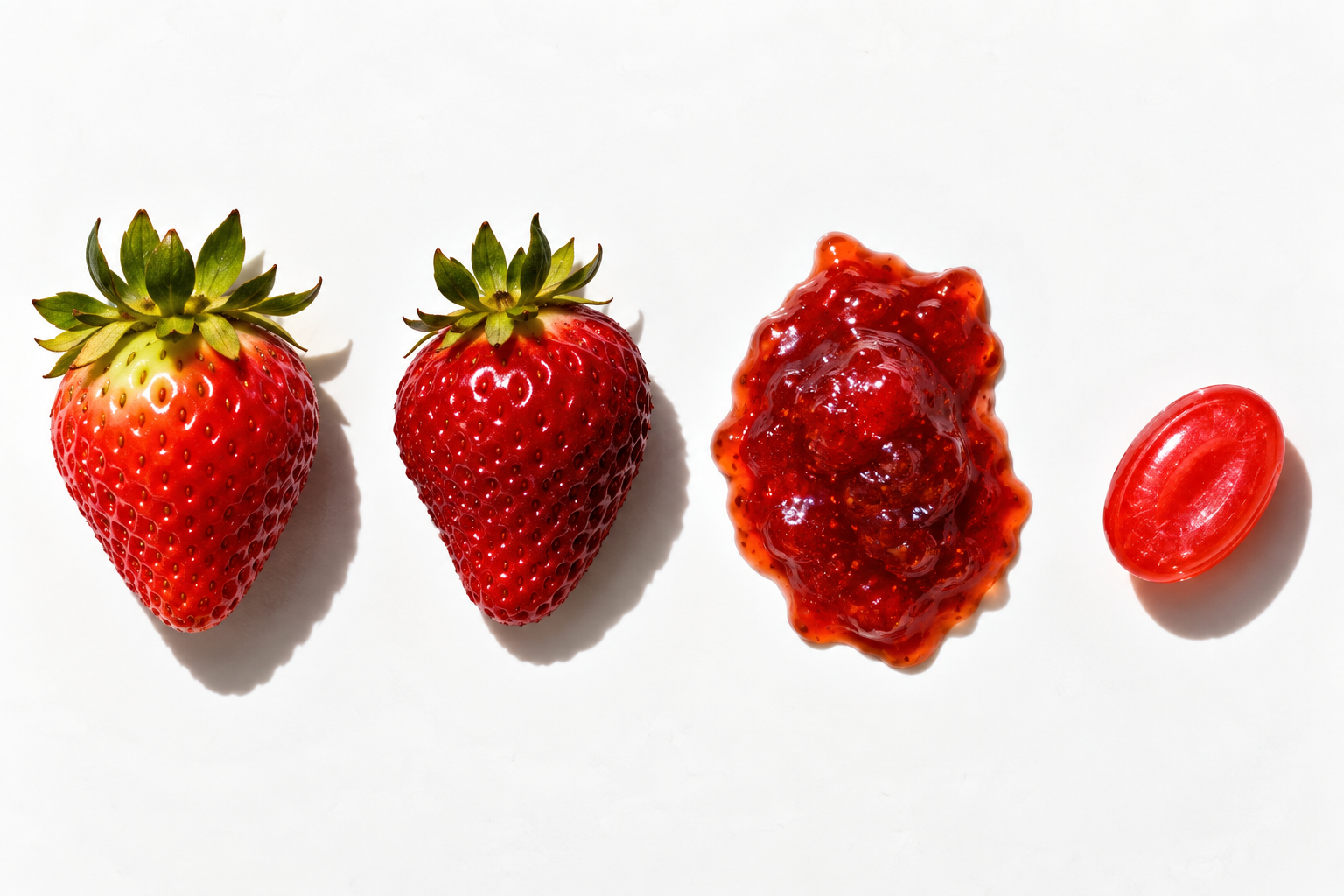
Strawberry sounds specific until you have to formulate one. A fresh strawberry, an overripe strawberry, strawberry jam and strawberry candy are all recognizably strawberry, but they get there through different combinations of compounds, along with sweetness, acidity and everything else happening in the food or drink.
So when a reformulation makes the strawberry seem “less strawberry,” adding more strawberry flavor may not get you back. Some of the fresh aroma may have disappeared. A change in sweetness can make the fruit seem less ripe. A new ingredient can get in the way of something that used to come through clearly. Figuring out what actually moved gives you a better place to start.
THE REST OF THE PRODUCT GETS A SAY
Take sugar out of a beverage and you haven’t only changed how sweet it is. It can also shift how the fruit flavor shows up, how long sweetness sticks around and how the flavor carries from the first sip through the finish.
One customer came to Brookside after reducing sugar in an existing beverage and then struggled to get the new version to taste like the profile they wanted to preserve. The reduction meant sweetness was concentrated at the very top of the sip, then quickly lost impact through the middle and left the finish hollow. Simply adding more flavor wasn’t going to solve for that. Our team worked on the sweetness system
instead, rebuilding the way sweetness carried through the sip so the beverage could hit its reduced-sugar target without losing the intended flavor experience.
Fat creates its own set of considerations. Besides richness and mouthfeel, fat affects how some aroma compounds are held and released as you eat. Reduce or remove fat from a dairy product, sauce or dressing, and a flavor that worked perfectly well before may suddenly show up differently. Protein can be just as disruptive, particularly at higher levels. Depending on the protein and the product, it can bring
bitterness, astringency or other off-notes that have to be accounted for. Heat can knock down some aromas while creating others. And extending shelf life gives oxygen, light and time more opportunity to change the flavor that tasted great when the product was first made.
FOUR FAMILIES OF FLAVOR COMPOUNDS WORTH KNOWING
ESTERS
Esters are a family of flavor compounds responsible for many of the fruity aromas associated with banana, pineapple, pear, strawberry and other fruits. Which esters are present, how much of them you have and how they’re proportioned can help push a fruit toward fresh, ripe, juicy, cooked or candy-like. That’s why a fruit flavor that’s close but somehow wrong may need something more precise than making it stronger.
TERPENES
Terpenes are important flavor compounds in citrus, herbs, hops and other botanicals. Twist a piece of lemon peel and that first rush of aroma gives you a pretty good introduction. Many of those bright aromatic notes are volatile, which also leaves them vulnerable to processing, oxidation and storage. The citrus you taste when a beverage is made isn’t guaranteed to be the citrus you’ll taste months later.
PYRAZINES
Pyrazines are flavor compounds that contribute many of the roasted, toasted and nutty characteristics found in foods like roasted coffee and toasted nuts. Some are created during heating through reactions such as the Maillard reaction. It’s part of what separates “chicken” from “roasted chicken.” You didn’t just turn the chicken flavor up. Browning created character that wasn’t there before.
ALDEHYDES
Aldehydes cover a surprisingly wide range of flavor territory, contributing citrusy, green, fatty, floral, warm and spicy notes depending on the compound. Cinnamaldehyde is the one most people know: it provides much of cinnamon’s characteristic aroma. Others may be doing quieter work in the background until a reformulation changes the balance and suddenly makes a green, fatty or citrus note more noticeable.
They aren’t four knobs on a control panel. You can’t just turn up esters for “more fruit” or pyrazines for “more roast.” The specific compounds matter, along with how much is there and what they’re interacting with in the finished product.
HOW PROCESSING AND SHELF LIFE CHANGE FLAVOR
Brookside saw that in a citrus beverage project where several flavor systems could hit the desired profile when the product was first made. The harder part was keeping that brightness through the intended shelf life. The system was reformulated around what happened over time so the citrus character held rather than winning the first tasting.
When the change happens can tell you a lot. Something that tastes wrong before processing points in a different direction from something that changes after heat. A flavor that slowly fades during storage gives you another set of clues. That’s more useful than starting another round of reformulation without knowing which problem you’re trying to fix.
WHEN YOU NEED TO MATCH AN EXISTING FLAVOR
Sometimes the product is fine. It’s the flavor you need to replace. Maybe you’re changing flavor suppliers, an existing flavor is no longer available, cost has become an issue or you need a natural version of something that already works. The assignment is different from developing a new flavor: you already know what it should taste like. The job is getting back there with a different flavor system.
That can be harder than it sounds. Two flavors can taste remarkably close on their own and behave differently once they’re in the finished product. Source, composition, stability and the rest of the formula can all affect how close the match actually gets.
When a match keeps getting close but not quite there, the difference may not be something you can solve by adjusting the flavor sample alone. How the replacement behaves in the formula or through processing can be part of what you’re tasting.
Flavorists can use sensory evaluation alongside analytical tools such as gas chromatography-mass spectrometry (GC-MS) when they need to investigate further. GC-MS can help separate and identify individual chemical components in a complex mixture, making it useful for comparing samples or understanding why two products that seem similar don’t smell or taste the same.
BEFORE YOU CHANGE THE FLAVOR AGAIN
Before assuming the next flavor sample is the answer, take inventory of what changed around it. Start with what changed in the formula and when you first noticed the difference. Did it happen before or after processing, or only after sitting for three months? Describe what actually moved in the eating or drinking experience. Maybe the first sip is right and the finish is gone.
You don’t need to know which ester disappeared or what happened to a volatile compound during processing. Knowing what changed, when it changed and what you’re trying to protect gives everyone a better place to start.
Tell Us What You’re Working On →
about feed your mind.
Articles from Brookside Flavors & Ingredients for people who think about food for a living. (And probably when they’re not working, too.)
Food. Beverages. Flavor. Science. Culture. Strange questions. Useful rabbit holes.